
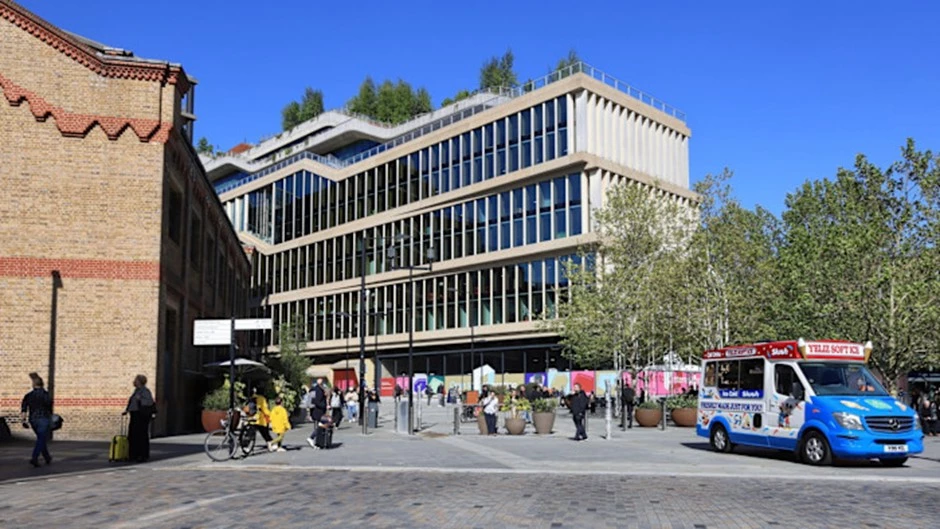
King’s Cross has completed one of the most dramatic urban transformations in modern London, evolving from a long-neglected industrial pocket into a world-class hub for technology, research and innovation. The district’s rise is set to reach another milestone later this year with the opening of Google’s long-awaited UK headquarters a 330-metre “landscaper” designed to house thousands of employees.
The tech giant first broke ground on the project in 2017, and its scale and ambition mirror the wider regeneration of the 67-acre site. Once characterised by derelict warehouses and disused railway land, King’s Cross has been reshaped over decades into a thriving mixed-use neighbourhood of offices, homes, retail and public spaces.
A magnet for global AI companies
The area’s growing reputation as London’s new centre of gravity for technology has been reinforced by the arrival of two major US AI players, OpenAI and Anthropic, both of which are establishing European bases in King’s Cross. They join an expanding ecosystem that already includes Google DeepMind led by Sir Demis Hassabis alongside fast-growing UK start-ups such as Synthesia and Wayve.
This concentration of AI and deep-tech firms has shifted London’s innovation map. Where Shoreditch’s “Silicon Roundabout” once symbolised the city’s start-up energy, King’s Cross has now taken the lead as the preferred location for advanced research, venture capital and high-growth technology companies.
Decades of investment paying off
The district’s resurgence did not happen overnight. After years of stalled proposals and local opposition, momentum finally built following the 2007 relocation of the Eurostar terminal to neighbouring St Pancras. More than £3bn of investment has since been channelled into the area, creating a carefully balanced blend of commercial development and public realm.
The result is widely regarded as one of the UK’s most successful regeneration projects and a reminder that long-term planning, even when slow and contested, can deliver exceptional outcomes.
Strategic advantages driving growth
King’s Cross benefits from a combination of factors that make it uniquely attractive to global tech and life-science companies:
• Unrivalled transport links, including direct connections to Cambridge home to Arm and a cluster of biotech start-ups and high-speed rail to Paris and other European cities.
• Proximity to leading universities, particularly University College London and Central Saint Martins, which supply talent and research partnerships.
• A growing life-sciences corridor, with AstraZeneca, GSK and AI-driven drug discovery companies such as Isomorphic Labs establishing a presence.
This convergence of academia, technology and biomedical research is helping to shape King’s Cross into one of Europe’s most dynamic innovation districts.
A neighbourhood designed for living as well as working
Unlike traditional office-led developments, King’s Cross was conceived as a mixed-use destination from the outset. Its residential buildings, shops, restaurants and cultural venues ensure the area remains active throughout the week a model now being emulated by other business districts such as Canary Wharf.
Challenges and opportunities ahead
The district’s success has brought rising property values and concerns about inequality, particularly in neighbouring Somers Town, which remains one of the area’s more deprived communities. There is also ongoing debate about the UK’s ability to retain ownership of its tech success stories, with much of the investment flowing into King’s Cross coming from overseas.
Even so, the district stands as a powerful example of what long-term vision, public-private collaboration and strategic planning can achieve. Once a symbol of urban decline, King’s Cross is now integral to London’s identity and increasingly central to Europe’s technology and AI landscape.
Source The FT