
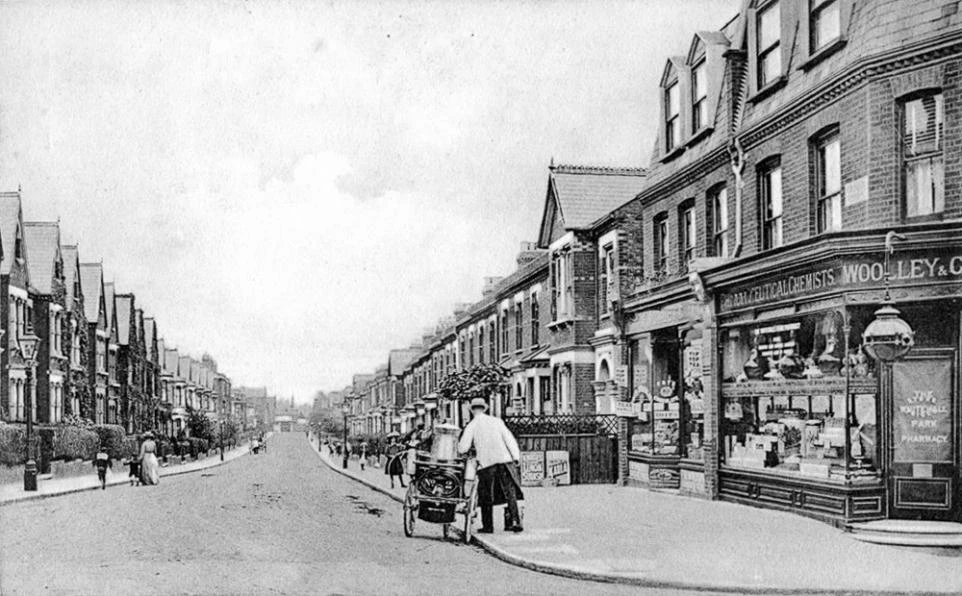
Stretching east of Archway Bridge, the conservation area drops sharply from Hornsey Lane down towards St John’s Way. Its southern edge skirts the former Islington Workhouse site before reaching the upper section of Sunnyside Road.
Many residents first discover the area much as David Seton and his wife did in the early 1980s drawn in by its peaceful, tree lined streets and the cohesive charm of its late Victorian terraces, all remarkably tranquil given their proximity to the constant flow of Archway Road. The couple eventually settled in Gresley Road, captivated by sweeping views of London from the upper floors.
Despite inevitable changes over the decades, the neighbourhood has retained its character. Long standing residents often remark that newcomers quickly develop a strong sense of belonging and curiosity about the area’s past. For David Seton, that curiosity became a passion, he researched and wrote a detailed history of Whitehall Park, originally published on the local residents’ association website and now released by the Hornsey Historical Society. The book is richly illustrated with historic maps, plans and photographs, tracing the evolution of this distinctive hillside community.
Historically, the land to the northeast formed part of the Trays (or Trayers) Hill Estate, while fields to the west belonged to the Wase family. Major change arrived in the early 19th century when the Highgate Archway Company acquired land to build a long-needed bypass to the steep Highgate Hill. Their ambitious tunnel collapsed dramatically in 1812, leading to the construction of a brick archway and bridge later that year. The current bridge, completed in 1900, still marks the western boundary of the conservation area.
By the mid-1800s, development remained sparse. The grand Whitehall mansion dominated the landscape south of Hornsey Lane, while a small cluster of homes emerged at St John Ville though progress was slowed by severe drainage issues and an overflowing open sewer.
In the late 1850s, the Trays Hill Estate was marketed as a prime building opportunity boasting “extensive and beautiful views” and enviable proximity to Highgate, Crouch End and Hornsey Station. Yet construction remained slow, likely hindered by the steep terrain. One rare survivor from this early phase is Sunny Bank (now 1 Dresden Road), built in 1859 for radical journalist Collet Dobson Collet, a close associate of Karl Marx.
The pace of development accelerated from the late 1870s and surged again after prominent developer John Cathles Hill purchased the Whitehall Park Estate in 1888. By 1893, the elegant terraces of Whitehall Park, along with the homes on Gladsmuir and Harberton Road, had taken shape. The transformation continued into the 20th century, Whitehall mansion was demolished around 1912, and the houses of Fitzwarren Gardens built in a distinctly different architectural style now occupies the site.
Today, Whitehall Park remains a tightly knit, characterful enclave with a strong sense of place a testament to the layered history that shaped its streets, slopes and skyline.
https://www.hamhigh.co.uk/news/26018087.history-whitehall-park-highgate-archway/
Written by Abdul
Source The Ham & High